
When Halal Chinese Food Becomes an Everyday Choice
This article explores how Taibat, a halal‑Chinese restaurant chain with Xinjiang‑Uyghur culinary influences, has integrated itself into daily community life through its two Southern California outlets in Santa Ana and Artesia. The Santa Ana location, Taibat Noodle House, is situated amid offices and busy shopping districts. It caters to quick, casual everyday needs: office‑worker lunches, post‑shopping meals and convenient stop‑in dining, turning halal Chinese cuisine from a special‑occasion novelty into a routine grab‑and‑eat option for diners with varying familiarity with Xin‑style food. By contrast, the larger Artesia branch features an expanded menu plus large‑format party trays. It is built for group occasions including family dinners, friend reunions and community gatherings, functioning as a venue for shared collective meals. For Muslim patrons, Taibat fills a local gap: it offers authentic Chinese‑style dishes fully compliant with halal standards, removing the need for separate dietary arrangements for mixed‑dining groups. Though both locations serve the same core halal Chinese‑Xinjiang cuisine, they adapt to distinct local lifestyles — one for busy on‑the‑go moments, the other for communal get‑togethers. The piece argues that a restaurant’s real success lies in evolving from an exotic new discovery into a familiar, regular community dining choice.
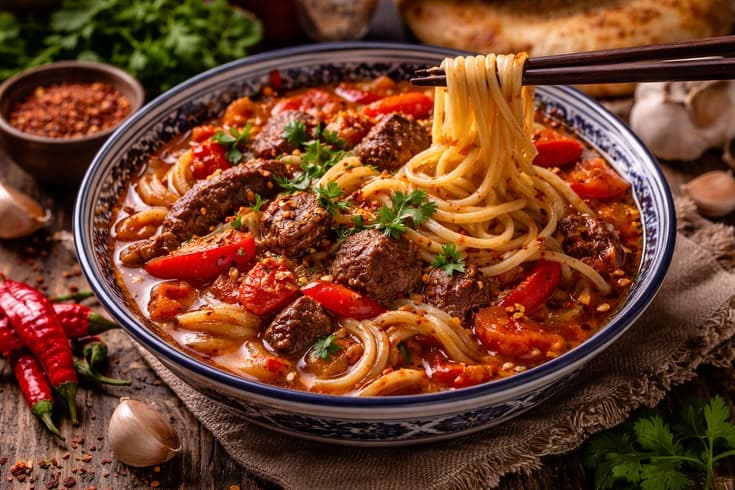
Southern California is full of restaurants that introduce people to something new.
A cuisine from another part of the world. A dish someone has never tried before. A restaurant that becomes a destination because it feels different from everything around it.
But there is another, quieter stage in the life of a restaurant.
It happens when the food stops being something people seek out only because it is unusual.
Instead, it becomes part of an ordinary decision:
What should we eat for lunch?
Where should we go after shopping?
What can the whole family share tonight?
That may be one of the most interesting ways to look at Taibat's two Southern California locations.
Both restaurants serve halal Chinese food with Xinjiang and Uyghur influences, but they fit into everyday life in very different ways. One sits near offices and one of Orange County's busiest shopping areas. The other has the kind of menu structure that makes sense for family meals, gatherings, and larger groups.
The result is not simply two restaurants in two cities.
It is two different answers to the same question:
How does a restaurant become part of a community's routine?
In Santa Ana, a Restaurant Can Fit Between Everything Else
Taibat Noodle House is located on West MacArthur Boulevard in Santa Ana, near the South Coast Metro area and close to the Costa Mesa border.
This is not the kind of place where every meal is a long, planned event.
The area combines office buildings, retail, major roads, and the traffic surrounding South Coast Plaza. On a weekday, people may be looking for lunch between meetings. On weekends, the same area brings in shoppers and visitors who want somewhere to eat before heading home.
That changes the role a restaurant can play.
A small noodle house can become part of the rhythm of the neighborhood.
Someone working nearby might stop in for lunch. A shopper might look for a meal after spending the afternoon around South Coast Plaza. A family driving through the area may want somewhere with convenient parking and a menu that offers more than one kind of dish.
The important thing is that halal Chinese food does not have to be reserved for a special occasion.
It can simply be lunch.
That is an interesting position for Taibat Noodle House.
The menu gives diners several ways to approach the restaurant. Someone can order noodles. Someone else may choose a familiar Chinese-American dish. Another person at the table may be looking specifically for lamb or Xinjiang-style food.
Those choices allow the restaurant to serve people with different levels of familiarity.
One person may arrive because they already know what laghman is.
Another may have never tried hand-pulled noodles before.
Neither person needs the same reason to walk through the door.
That is often how a restaurant becomes more deeply connected to a neighborhood. It does not require every customer to understand the entire culinary tradition behind the food.
Sometimes the restaurant simply needs to offer something that works for the moment.
In Artesia, the Table Can Be the Center of the Experience
The Taibat location in Artesia tells a different story.
The restaurant is larger, the menu is much broader, and one part of the menu immediately changes how people might think about eating there: large-format party trays.
That matters because food is not always organized around an individual order.
Sometimes the meal begins with a group.
A family deciding what to have for dinner.
Friends meeting after work.
A holiday gathering.
A community event.
A table where everyone expects to share.
Artesia's Taibat Restaurant has a menu structure that makes room for those occasions. Alongside individual dishes and weekday lunch options, the restaurant offers dozens of Party Trays designed for larger groups.
This creates a different relationship between the restaurant and the people around it.
The restaurant is not only a place to visit when one person is hungry.
It can also become part of the logistics of bringing people together.
That distinction may sound simple, but it changes the way a restaurant fits into a community.
A bowl of noodles and a large shared tray are both meals, but they belong to different moments.
One fits into a busy day.
The other can become part of an event.
From "Something Different" to "Something We Can All Eat"
For halal diners, there is another layer to this story.
In many places, finding halal food can still mean choosing from a relatively limited range of cuisines.
A diner may know exactly where to find halal South Asian food, Middle Eastern food, or a halal butcher. But Chinese food is not always automatically included in the same list of everyday options.
That is where restaurants like Taibat create a different kind of choice.
The point is not simply that the food is Chinese.
And it is not simply that it is halal.
The more interesting idea is that those two things exist together as a normal restaurant option.
A family can choose Chinese food without separating the table into different dietary needs.
Friends can order a mix of noodles, lamb dishes, stir-fried dishes, and other familiar Chinese-style meals while knowing that the restaurant follows halal standards.
For some customers, that may be the reason they visit.
For others, it may simply be one part of what makes the restaurant work.
That combination is what allows a restaurant to move beyond being a novelty.
The food can be interesting without the restaurant needing to feel unfamiliar.
Two Locations, Two Everyday Moments
The difference between the Santa Ana and Artesia locations can be understood through a simple contrast.
In Santa Ana, the restaurant fits into movement.
People are commuting, working, shopping, and moving through one of the busiest parts of Orange County. A convenient meal has value.
In Artesia, the restaurant can fit into gathering.
The larger menu and party trays create opportunities for meals built around families and groups rather than only individual orders.
Neither approach is better.
They simply reflect two different ways restaurants become useful to the people around them.
This may also explain why a restaurant should not always tell exactly the same story in every city.
The same food can mean something slightly different depending on where and how people eat it.
A noodle dish can be a quick weekday lunch.
A large platter can become the center of a family dinner.
The restaurant itself stays connected to the same broader idea, but the role it plays changes.
The Most Successful Restaurants Eventually Become Part of the Routine
There is something important about the moment when a restaurant becomes an ordinary choice.
It means customers no longer have to ask:
"Have you ever tried this kind of food?"
Instead, the question becomes:
"Do you want to go there again?"
That shift is easy to overlook.
But it may be one of the strongest signs that a restaurant has found a place in its community.
Taibat's two Southern California locations show two different versions of that process.
In Santa Ana, halal Chinese food can fit into the middle of a workday or a shopping trip.
In Artesia, it can fit around a larger table, a family gathering, or a shared meal.
The food remains connected to the same culinary traditions, but the restaurant experience adapts to the everyday lives happening around it.
And perhaps that is the most interesting part of a local restaurant.
Not just where it comes from.
But where it fits.
Visit Taibat Noodle House in Santa Ana:https://taibat.hiraccoon.com
Visit Taibat Restaurant in Artesia:https://taibat-artesia.hiraccoon.com
Keep reading


Order from
Santa Ana, CA · Halal Chinese (Xinjiang)
Artesia, CA · Halal Chinese (Xinjiang & Uyghur)